
Guidelines development process
IWGDF Consensus guidelines development process
Aim
The aim of the document is to provide guidelines for prevention and treatment that will reduce the impact of diabetic foot disease, by means of quality health care with consideration of costs and using the principles of evidence based medicine augmented with expert opinion. In the document the basic concepts in diabetic foot care are addressed, with clear description of the various diagnostic, preventive or therapeutic strategies. Furthermore, the organization of care and the implementation of the guidelines are described.
Methods used to design the IWGDF guidelines
The recommendations in the specific guidelines were linked to supporting scientific evidence. To identify the available literature, a systematic search was performed of the currently available electronic databases using pre-defined search strategies. Subsequently, data was abstracted systematically and the literature was graded according to methodological quality to assess the strength of the evidence. For the applicability of the recommendations for daily clinical practice the recommendations were judged with regard to generalisability, applicability, and the clinical impact. In this manner the link was made between the scientific evidence and recommendations for daily clinical practice. While much insight has been gained from studies of normal subjects, only studies which drew from the target population of diabetic patients have been included. As might be expected, some published work of members of the committee was considered in the review and strict rules were used to guard against conflict of interest. Extracted data were summarized in evidence tables. The evidence tables were compiled following collective discussion within each working group and conclusions were drawn in the review reports and subsequently recommendations were formulated as specific guidelines. All document were written without any influence from the pharmaceutical industry or other interest groups.
Consensus
After careful consideration by the IWGDF Editorial Board the 2011 review reports and specific guidelines were sent to the IWGDF representatives from over 100 countries for comments. On a special Consensus Day prior to the 6th International Symposium on the Diabetic Foot (ISDF) in May 2011, all representatives were invited to reach consensus on the three specific guidelines. During that day some additional comments were incorporated in the texts and the final texts were eventually endorsed by the IWDGF representatives. These 2011 review reports and guidelines on wound healing, infection and PAD are published in the Supplement of the DMRR issue February 2012 (see References)
The guideline project of the IWDGF is a rather unique project, it is truly multidisciplinary with the participation of the many disciplines involved in the diabetic foot, it is a continuous process for already 15 years and a world wide implementation is guaranteed by the more than 100 country representatives. The future will see the further implementation and evaluation of the IWGDF Consensus Guidelines 2011. These guidelines will be further developed to keep in step with advances in research and practice; moreover, they will be expanded to include more topics once sufficient evidence is present to enable an evidence based consensus process.
More than ever before, it is imperative that appropriate action be taken to ensure access to quality care for all people with diabetes, regardless of their age, geographic location or social status .The IWGDF hopes that global awareness of diabetes and foot complications will continue to increase. The need for improved foot care for people with diabetes throughout the world must be recognized. If the IWDGF recommendations are followed, the improved management of the diabetic foot will undoubtedly lead to an worldwide reduction in limb loss.

Acknowledgements
IWGDF would like to express its deep gratitude to the many authors and members of the working groups who have collaborated tirelessly, lending their expertise and dedication to the realization of this huge project.
Sincere thanks also go to the sponsors, who, by providing generous and unrestricted educational grants, they made it possible for IWGDF to develop the International Consensus and Practical and Specific Guidelines on the management of the diabetic foot 2011.
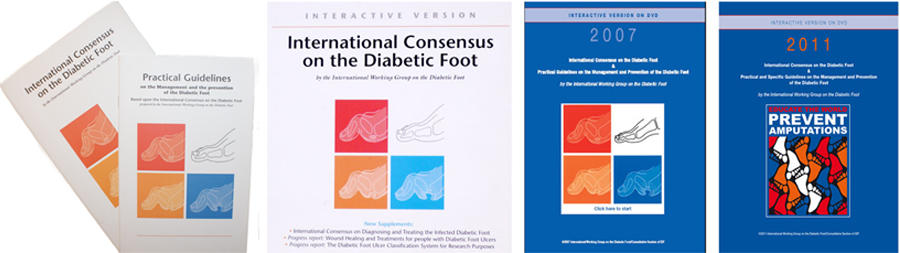
IWGDF DVD’s with all guideline texts, reviews and other documents can be purchased through the IDF website at: http://shop.idf.org
References:
Schaper NC, Van Houtum WH, Boulton AJW; Proceedings of the 6th International Symposium on the Diabetic Foot, May 10-14, 2011 Noordwijkerhout, The Netherlands.IWGDF Guidelines. Diabetes Metab Res Rev. 2012 Feb;28 Suppl 1:116-237
K. Bakker , N.C. Schaper on behalf of the International Working Group on the Diabetic Foot (IWGDF) Editorial Board; The development of global consensus guidelines on the management and prevention of the Diabetic Foot 2011. Diabetes Metab Res Rev 2011; 28 Suppl 1:S1:116-18